| Physical | Nominal Value | Unit | Nominal Value | Unit | Test Method | ||||
| Density / Specific Gravity | 0.037 | lb/in3 | 1.040 | g/cm3 | ASTM D1505 | ||||
| Mechanical | Nominal Value | Unit | Nominal Value | Unit | Test Method | ||||
| Tensile Modulus | 329000 | psi | 2270 | Mpa | ASTM D638 | ||||
| Tensile Strength (Yield) | 6380 | psi | 44 | Mpa | ASTM D638 | ||||
| Tensile Strength (Break) | 4790 | psi | 33 | Mpa | ASTM D638 | ||||
| Tensile Elongation (Yield) | 2 | % | 2 | % | ASTM D638 | ||||
| Tensile Elongation (Break) | 24 | % | 24 | % | ASTM D638 | ||||
| Flexural Modulus | 334000 | psi | 2305 | Mpa | ASTM D790 | ||||
| Flexural Strength | 10200 | psi | 70 | Mpa | ASTM D790 | ||||
| Impact | Nominal Value | Unit | Nominal Value | Unit | Test Method | ||||
| Notched Izod Impact 73ºF (23ºC) | 6 | ft-lb/inch | 320 | J/m | ASTM D256 | ||||
| Instrumented Dart Impact 73ºF (23ºC) Total Energy | 266 | in-lb | 30 | J | ASTM D3763 | ||||
| Hardness | Nominal Value | Unit | Nominal Value | Unit | Test Method | ||||
| Rockwell Hardness | 112 | R scale | 112 | R scale | ASTM D785 | ||||
| Thermal | Nominal Value | Unit | Nominal Value | Unit | Test Method | ||||
| Deflection Temperature 66 psi | 201 | ºF | 93.96 | ºC | ASTM D648 | ||||
| Deflection Temperature 264 psi | 176 | ºF | 80.06 | ºC | ASTM D648 | ||||
| Vicat Softening Temperature | 210 | ºF | 98.97 | ºC | ASTM D15252 | ||||
| Electrical | Nominal Value | Unit | Nominal Value | Unit | Test Method | ||||
| Arc Resistance | PLC 6 | PLC 6 | ASTM D495 | ||||||
| Comparative Tracking Index (CTI) | PLC 0 | PLC 0 | UL 746A | ||||||
| High Amp Arc Ignition (HAI) | PLC 0 | PLC 0 | UL 746A | ||||||
| High Voltage Arc Resistance to Ignition (HVAR) | PLC 3 | PLC 3 | UL 746A | ||||||
| Hot-wire Ignition (HWI) | PLC 3 | PLC 3 | UL 746A | ||||||
| Flammability | Nominal Value | Unit | Nominal Value | Unit | Test Method | ||||
| Flammability Rating | HB @ .059 | HB @ 1.5mm | UL94 | ||||||
| * This information is based on average resin value specifications and is only to assist and advise you on the current technical knowledge, it is given without obligations or liability. | |||||||||
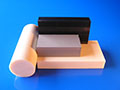
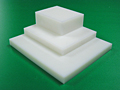
/Asset/ABS_shapes.jpg

Acetal polymers, referred to chemically as POM PolyOxyMethylene, are semi-crystalline engineering thermoplastics made by the polymerization of formaldehyde. They have physical properties that are not available with metals or most other plastics; high mechanical strength and rigidity, low coefficients of friction, low moisture absorption, excellent dimensional stability, fatigue endurance, and resistance to abrasion and creep. These materials are also resistant to a wide range of solvents and have good electrical properties.
Applications
• Structural components
• Bearings, bushings, wear pads
• Gears
• Electrical components
• Jigs and fixtures
• Pump and valve parts
• Medical components
Characteristics
• Low moisture absorption
• Low coefficient of friction
• High strength and stiffness
• Excellent electrical properties
• Good chemical resistance
• Easy to fabricate
Acetal polymers, referred to chemically as POM PolyOxyMethylene, are semi-crystalline engineering thermoplastics made by the polymerization of formaldehyde. They have physical properties that are not available with metals or most other plastics; high mechanical strength and rigidity, low coefficients of friction, low moisture absorption, excellent dimensional stability, fatigue endurance, and resistance to abrasion and creep. These materials are also resistant to a wide range of solvents and have good electrical properties.
Applications
• Structural components
• Bearings, bushings, wear pads
• Gears
• Electrical components
• Jigs and fixtures
• Pump and valve parts
• Medical components
Characteristics
• Low moisture absorption
• Low coefficient of friction
• High strength and stiffness
• Excellent electrical properties
• Good chemical resistance
• Easy to fabricate
Acetal polymers, referred to chemically as POM PolyOxyMethylene, are semi-crystalline engineering thermoplastics made by the polymerization of formaldehyde. They have physical properties that are not available with metals or most other plastics; high mechanical strength and rigidity, low coefficients of friction, low moisture absorption, excellent dimensional stability, fatigue endurance, and resistance to abrasion and creep. These materials are also resistant to a wide range of solvents and have good electrical properties.
Applications
• Structural components
• Bearings, bushings, wear pads
• Gears
• Electrical components
• Jigs and fixtures
• Pump and valve parts
• Medical components
Characteristics
• Low moisture absorption
• Low coefficient of friction
• High strength and stiffness
• Excellent electrical properties
• Good chemical resistance
• Easy to fabricate
Acetal polymers, referred to chemically as POM PolyOxyMethylene, are semi-crystalline engineering thermoplastics made by the polymerization of formaldehyde. They have physical properties that are not available with metals or most other plastics; high mechanical strength and rigidity, low coefficients of friction, low moisture absorption, excellent dimensional stability, fatigue endurance, and resistance to abrasion and creep. These materials are also resistant to a wide range of solvents and have good electrical properties.
Applications
• Structural components
• Bearings, bushings, wear pads
• Gears
• Electrical components
• Jigs and fixtures
• Pump and valve parts
• Medical components
Characteristics
• Low moisture absorption
• Low coefficient of friction
• High strength and stiffness
• Excellent electrical properties
• Good chemical resistance
• Easy to fabricate

Acetal polymers, referred to chemically as POM PolyOxyMethylene, are semi-crystalline engineering thermoplastics made by the polymerization of formaldehyde. They have physical properties that are not available with metals or most other plastics; high mechanical strength and rigidity, low coefficients of friction, low moisture absorption, excellent dimensional stability, fatigue endurance, and resistance to abrasion and creep. These materials are also resistant to a wide range of solvents and have good electrical properties.
Applications
• Structural components
• Bearings, bushings, wear pads
• Gears
• Electrical components
• Jigs and fixtures
• Pump and valve parts
• Medical components
Characteristics
• Low moisture absorption
• Low coefficient of friction
• High strength and stiffness
• Excellent electrical properties
• Good chemical resistance
• Easy to fabricate
Acetal polymers, referred to chemically as POM PolyOxyMethylene, are semi-crystalline engineering thermoplastics made by the polymerization of formaldehyde. They have physical properties that are not available with metals or most other plastics; high mechanical strength and rigidity, low coefficients of friction, low moisture absorption, excellent dimensional stability, fatigue endurance, and resistance to abrasion and creep. These materials are also resistant to a wide range of solvents and have good electrical properties.
Applications
• Structural components
• Bearings, bushings, wear pads
• Gears
• Electrical components
• Jigs and fixtures
• Pump and valve parts
• Medical components
Characteristics
• Low moisture absorption
• Low coefficient of friction
• High strength and stiffness
• Excellent electrical properties
• Good chemical resistance
• Easy to fabricate
Acetal polymers, referred to chemically as POM PolyOxyMethylene, are semi-crystalline engineering thermoplastics made by the polymerization of formaldehyde. They have physical properties that are not available with metals or most other plastics; high mechanical strength and rigidity, low coefficients of friction, low moisture absorption, excellent dimensional stability, fatigue endurance, and resistance to abrasion and creep. These materials are also resistant to a wide range of solvents and have good electrical properties.
Applications
• Structural components
• Bearings, bushings, wear pads
• Gears
• Electrical components
• Jigs and fixtures
• Pump and valve parts
• Medical components
Characteristics
• Low moisture absorption
• Low coefficient of friction
• High strength and stiffness
• Excellent electrical properties
• Good chemical resistance
• Easy to fabricate

Acrylic (PMMA) materials have an unusual combination of properties, outstanding weather resistance, brilliant clarity, "light-piping" and "edge-lighting" qualities, chemical resistance, and ease of forming and machining. Compared to all other types of transparent thermoplastics, acrylic has outstanding resistance to the damaging effects of sunlight and outdoor weathering. Acrylic is often recognized under brand names such as Acrylite®, Plexiglas®, Lucite®, Optix®, Polycast®, Perspex® and Chemcast®.
/Asset/Acrylite3.jpg
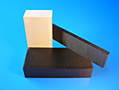

Cast Nylons are a range of polyamides produced by a casting process involving the anionic polymerisation of caprolactum. This process allows the production of semi-finished plate, rod, tube and custom castings that are largely free of internal stresses. Natural Cast Nylon is the basic grade from which all other grades of Cast Nylons stem. Generally accepted as the primary engineering polymer, Natural Cast Nylon is suitable for virtually any plain bearing application not to mention a huge range of other applications for which this versatile grade finds a use. By varying the conditions of polymerisation the mechanical properties of Cast Nylon may be altered to suit specific applications and the addition of various additives, fillers, lubricants and colorants.
Nylon 6 Oil-filled PA6 is a self-lubricating, oil-filled polyamide that is an ideal solution for industrial applications in the conveying and processing industries. This grade in particular exhibits higher toughness and limiting pressure velocity when compared to unfilled grades and also offers a low coefficient of friction for a wide range of applications including bushings, bearings, roller wheels, valve seats and seals. It increases the load- bearing performance of the material when compared to unfilled nylons and reduces the coefficient of friction.




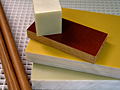
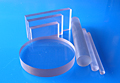
Polycarbonate is an amorphous engineering thermoplastic, which is charactarized by high levels of mechanical, optical, electrical and thermal properties. Polycarbonate is one of the most widely used engineering materials in the world and has contributed to product revolutions in virtually every industry. Polycarbonate shapes have outstanding impact strength, superior dimensional stability, high temperature resistance and high clarity.
/Asset/PC14.jpg
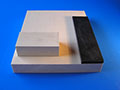

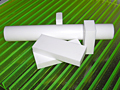
Radel®R is a Polyphenylsulfone (PPSU) suited primarily to applications in the medical industry. Radel®R is similar to Polysulfone (PSU) but has improved performance in terms of temperature, impact strength and chemical resistance. Radel®R also has exceptional resistance to repeated steam autoclaving without loss of dimensional stability or physical properties.
/Asset/Misc Materials1.jpg
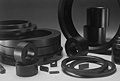
Torlon is the one of the highest performing, melt processable plastics available. It has superior resistance to elevated temperatures. It is capable of performing under severe stress conditions at continuous temperatures to 500°F (260°C). Parts machined from Torlon stock shapes provide greater compressive strength and higher impact resistance than most advanced engineering plastics. Torlon PAI’s extremely low coefficient of linear thermal expansion and high creep resistance deliver excellent dimensional stability over its entire service range. Torlon is an amorphous material with a Tg (glass transition temperature) of 537°F (280°C).
/Asset/TORLON11.jpg